
Relations between Developing and Developed Countries
- Nesa Raajan
- Dec 18, 2019
- 3 min read

A developing country, a less developed country, a less developed country (LEDC), is a region with a less advanced industrial base and a lower HDI compared to other countries. This description, however, is not universally agreed. There is also no clear understanding as to which countries fit this category. Also a reference point can be the GDP per capita of a country compared to other nations. The United Nations usually supports the argument of any nation to be "developing." The phrase "developing" describes a situation that is currently being observed and not a dynamic or expected progress direction that changes. Developing countries have tended to show higher rates of growth than developed countries since the late 1990s.
A developed country, industrialized country, or more economically developed nation (MEDC), is a sovereign state with a developed economy and technologically advanced resources in contrast with other less industrialized countries. Most generally, the metrics for determining the degree of economic growth are gross domestic product (GDP), gross national product (GNP), per capita income, extent of industrialization, large-scale services and general living standards. Developed countries generally have more advanced post-industrial economies, meaning more wealth is provided by the service sector than by the industry. These compete with developing countries that are either in the midst of industrialization or are pre-industrial and almost completely agrarian, some of which may fall into the Least Developed Countries group.
Trade between developed and developing countries often leads to difficult problems. Many less-developed countries have economies focused on agriculture, and many are tropical, allowing them to rely heavily on the export earnings of one or two crops, such as cocoa, cacao, or sugar. Markets are highly competitive for such goods, that is, costs are highly sensitive to any change in demand or supply. Conversely, the prices of manufactured goods are typically much more constant, the traditional exports of developed countries. Therefore, as the price of its export commodity fluctuates, the tropical country is experiencing major fluctuations in its "trade terms," the ratio of export prices to import prices, often with painful effects on the domestic economy. With regard to nearly all major primary commodities, efforts were made to stabilize the price and control the output. There has been mixed progress in these attempts.

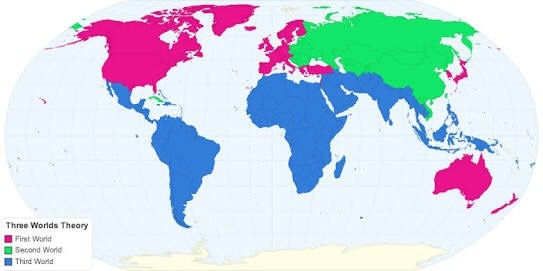
The North-South divide is a popularized Earth's socio-economic and political division in the late 20th and early 21st centuries. Global North definitions generally include the G8 countries, the United States, Canada, all EU Member States, Israel, Japan, Singapore, South Korea, Australia and New Zealand, and four of the five permanent members of the United Nations Security Council, except for China. Brazil, India, and China, the main and populated Southern states together with Indonesia. The North is mostly associated with the Western world and the First World, and much of the Second World, while the South refers mostly to the Third World and the Eastern World, while Latin America is often considered to be neither Eastern nor Western. The two classes are often defined as defined by indexes of freedom in terms of their various levels of wealth, economic development, income inequality, democracy, and political and economic rights. Nations in the North tend to be more prosperous, less poor, more egalitarian, and industrialized countries producing technologically advanced manufactured products. Southern states are generally poorer developing countries with younger, more vulnerable economies that are heavily dependent on exports from the primary sector and often share a legacy of Northern states ' past colonization. However, the North-South divide is often challenged and said to be increasingly inconsistent with truth.
In economic terms, with one quarter of the world's population as of the early 21st century, the North controls four-fifths of income earned anywhere in the world. Ninety percent of the manufacturing sector is owned and located in the North. Conversely, the South has access to one-fifth of the world's income, with three-quarters of the world's population. As nations develop economically, they can become part of the "North" definitions, irrespective of their geographical location; similarly, any nation that does not qualify for "developed" status is considered to be part of the "South" definition.


Comments